

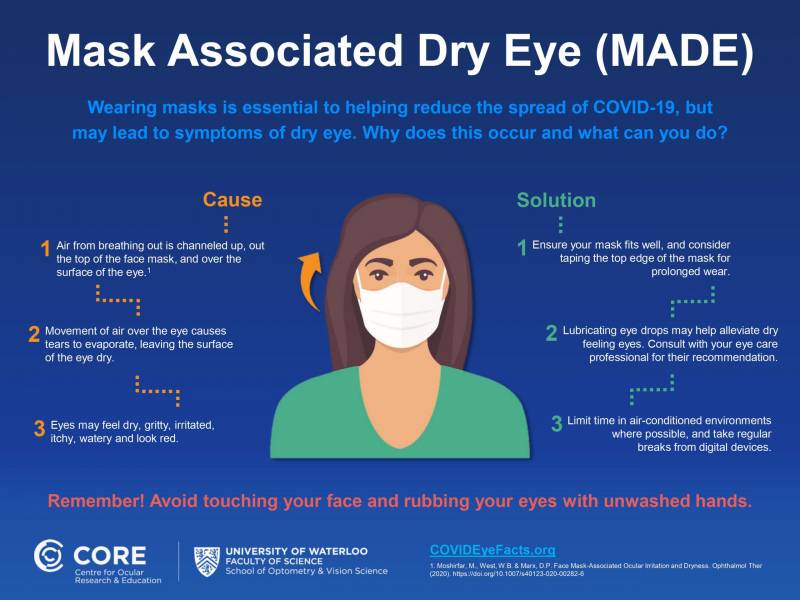
As face masks become part of our everyday COVID-19 life, the Centre for Ocular Research and Education (CORE) has recommended that eye care professionals share advice with patients experiencing face mask related dry-eye symptoms, described as Mask Associated Dry Eye (MADE).
Indeed, while masks reduce the outward spread of air, this air still needs to disperse and a loosely fitted mask can send it up over the surface of the eye, creating dry spots on the ocular surface. Not to mention that dry-eye symptoms could also lead people to rubbing their eyes at a time when experts are encouraging people to touch their face less.
“Face masks are crucial in the fight against COVID-19, and ECPs are well-positioned to provide patients with advice on appropriate wear in order to maximise eye comfort,” said Dr Lyndon Jones, director of CORE.
Emphasising the importance of the public continuing to wear masks, Dr Jones added: “Responsibly wearing a mask, even when having to contend with eye dryness, is a critical part of overcoming the global pandemic. The good news is that we understand MADE and can address it — an opportunity for ECPs to further communicate their knowledge and ongoing value to patients at a time when sound, scientific guidance is needed more than ever.”
The researchers’ key message to optometrists is to incorporate actions and questions around MADE into their examinations. As Karen Walsh, professional education team leader and clinical scientist at CORE, explains it, optometrists should “be proactive in asking about how patients’ eyes feel when wearing their mask and to be able to reassure them that there are a few steps they can take to help alleviate the issue and improve the comfort of their eyes, whilst maintaining mask-wearing in situations where social distancing is difficult.”
CORE has put together a list of tips for patients on their website, as well as an infographic about MADE.
Topic: Optical News
There are lots of benefits to becoming a member of the IOA:
Our sponsors


