

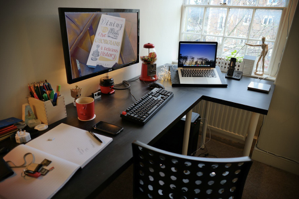
Patients who call upon optical practices spend an increasing number of hours in front of a computer or multiple digital devices, often working between 2 or 3 simultaneously, adding to the demands on their visual system.
This home office set up is now far from unusual : both a desktop pc and laptop clearly visible, adding a smartphone and sometimes a tablet into the mix. Patients expect to see them all clearly, and often at the same time!
Careful communication and questioning is needed to uncover specific needs, and a “visual task analysis” will enable the optician to recommend suitable optical appliances.
So, what’s a “visual task analysis”? It’s finding out from the patient what they do, and how they do it.
Questions to uncover needs could be:
Working distance(s) – Do they use multiple screens? Are they positioned at different distances? What is the direction of their gaze? Are screens above or below their head?
Size of task/font – Does the size of font differ dependent on the size of the screen? Are they looking at printed material in addition to the screens? Do they also wear a headset? Are they required to make notes?
Is the task static or moving - What are they actually looking at? Is it only a computer or perhaps do they look at a production line?
Is the worker static or moving – Do they sit at a desk all the time or are they required to move around? Do they alternate between standing and sitting? Do they move their head laterally or only up and down?
What is the position of the worker – Do they have to look at multiple screens above or below their head – are they off to the side?
How long is/are task(s) performed – Is there a ‘normal’ time? Is it the whole day or intermittent?
Lighting – Is it overhead or task specific?
Contrast – If working on a PC – does the software have good contrast or is it poor? Can it be changed to make the contrast better?
The necessity for colour accuracy – Does the job call for ‘colour matching’? Does the worker have to differentiate between different tones and hues of colour?
Potential hazards (in the workplace)- Trips and slips? Repetitive Strain Injury(RSI)?
Only by uncovering these needs can we begin to advise appropriately on suitable lens options to help the patient have comfortable vision. Great care should be taken to ensure we are in the best position to advise and recommend suitable lens types to each patient. Every patient should be treated as an individual – it is highly unlikely that two people will have the same work station set up and requirements from their vision. Time spent with the patient discussing their particular situation will help tailor your advice to meet their needs.
Topic: Optical News
There are lots of benefits to becoming a member of the IOA:
Our sponsors


